Hypothetical scenario:
(1) There’s a city board in charge of granting out public money. (2) A member of the board leads the effort to set aside as much money as possible to pay for administrative expenses. (3) The same member of the board then leads the effort to have the board pay her sister to do administrative work, while simultaneously acting as her sister’s agent and only point of contact with the board. (4) This is administrative work which used to be done by board members for free, which could be done by volunteers, and which no comparable board pays money for. (5) The work will not be put out to bid, and the board will not ask for volunteers to do the work.
Is this more or less corrupt if the board member is also the board’s treasurer?
Aren’t there laws that ban this sort of action?
If the board is determined to throw away money on work that could be done for free or more cheaply, is the waste of public funds more important than the nepotism?
Would sunlight help fix any of this?
I resigned hours after (2) happened. Can I retroactively resign before (2)?
How do I get this rid of this overwhelming nausea?
Wednesday, November 2, 2011
I’m not sure hypothetical is the right word

Wednesday, July 29, 2009
Watch the savings add up!
Andersen Windows e-mailed me a lengthy explanation of the trade-offs between their regular glass and their SmartSun glass, including a phenomenal example of math illiteracy:
Single Pane ReplacementYes, boys and girls, if you save 37% of your energy usage in the winter and 55% of your energy usage in the summer, you save 92% annually! If you want to save more, take your percentage of energy savings every day and add up all of those percentages: you could save 9000% or more!
Minneapolis
% Winter Energy Savings
% Summer Energy Savings
% Annual Energy Savings
HP4
39%
41%
80%
SmartSun
37%
55%
92%
Improvement
15%
Tuesday, May 5, 2009
CafePress and marketplace forces
CafePress is a print-on-demand service that allows people to upload designs and sell them on shirts and mugs and posters. CafePress has always allowed you to set the selling price for the objects you create. There’s a base price which covers the costs and profit for CafePress, and then you can add whatever you want to that and keep the difference. You can set up shops on their site, where you can organize a group of items you want to sell. A small shop is free, and a larger shop costs a little money.
Some people use CafePress to create objects for themselves or for friends and family. Some use CafePress to earn small or large amounts of money, or to raise funds for an organization. And some just use CafePress for the fun of it. Personally, I’ve got a few hundred items on CafePress, and I’ve made some meal money that way.
If you’re shopping on CafePress, you can search for items that anyone has created (unless they decided to keep the item private). CafePress calls this the Marketplace, even though it’s really just an extremely bad search engine. There are many reasons why the search engine is bad: the search algorithms are poorly written; results load slowly; the search engine depends on tags and too-short descriptions which frequently don’t accurately describe the design; it’s a little difficult to see more designs by the same person; it’s impossible to filter out designs or designers you don’t like; and the vast majority of the designs on CafePress are poorly done, so the vast majority of results for most searches are unappealing. But tastes vary, and there are many funny, unique, and attractive items on CafePress, so a lot of people do wander around CafePress, see something they like for themselves or for someone else, and order things. A Marketplace that let shoppers find things they like more easily would sell more—that’s why Amazon is so successful.
Until now, it hasn’t mattered much how people found a CafePress item that they wanted to buy: they might have followed a direct link to an item or to a shop, or been searching on Google, or been wandering around CafePress. (The affiliate program might take a 15% cut of some sales, and you might earn a bonus if you sold enough items through direct links to your shop, but those were fairly small variations.) For shoppers, it hasn’t mattered at all how they found the item they wanted to buy. CafePress and item creators all wanted to make it easier for shoppers to find items, so there was a sense of cooperation.
But starting June 1, CafePress has decided to pretend that the shops and the Marketplace are completely different. The same item will have two different prices, and the amount that the designer receives will be wildly different. Here’s an example:
I created a Rorschach blot design last winter and put it up on CafePress, where you can buy a number of different objects with the design printed on them.
Suppose you want this design on a tote bag. Right now, you can buy the tote bag for $16.99. If you do, I receive $4.00 and CafePress receives $12.99 (their base price). You might find the tote bag by following a link from here or somewhere else, or by searching on Google, or by searching on CafePress. The end result for you and for me will be the same in any of those situations.
Starting June 1, some links directly to the tote bag will give you a price of $16.99, and I’ll receive $4.00. But if you search on CafePress or follow other links to the tote bag, the tote bag will be $15 to $20 and I’ll receive 10% ($1.50 to $2.00). CafePress says that they will continue to change prices in the Marketplace, so you might pay more or less than the shop price, but I’ll definitely receive a lot less.
And CafePress says this is to make the customer experience more consistent, because they can set the price of all tote bags in the Marketplace to the same fluctuating amount.
Suddenly the sense of cooperation between CafePress and the designers is gone. I have to compete with CafePress to try to get a customer to follow one link to the tote bag instead of another. If I have a direct relationship with my customers, I have to explain why the same item is appearing at two different prices on the same site, and why one of those prices keeps changing. And I have to accept that an unknown and unauditable number of sales will result in much lower revenue. Many designers are looking at a 75% or greater reduction in the amount of money they’ll receive.
If I opt out of the Marketplace, then at least my items will have only one price and I’ll still receive the amount of money I set. But customers won’t be able to find my products using CafePress’ own search engine, even though my products will still be available on CafePress’ site if you come in from direct links or outside search engines. That’s bad for me (since customers using the CafePress search engine definitely won’t buy my products) and bad for CafePress (since customers who see a lot fewer items are less likely to buy anything). And it makes the search engine on CafePress completely defective.
The result is that a lot of the best-selling designers on CafePress are moving to Zazzle or somewhere else. Those designers are, by definition, the ones creating the designs that customers want to actually buy. As they leave, the ratio of good to bad designs on CafePress gets worse, which means fewer customers buying items from CafePress and a more negative sense of the quality of CafePress items.
My company has a CafePress shop to sell some light-hearted items. We can’t try to explain to our customers why a product is showing up at one price at http://www.cafepress.com/redrorschach.331991470 and another price at http://shop.cafepress.com/design/31466711. People who suspect that Amazon or Expedia are showing different prices to different customers get really angry, and with good reason. We also don’t want to see our best-selling item (a classroom poster) change from a $15 profit to a $2 profit. So we’ll be opting out of the Marketplace now as the best way to both avoid those problems and not have to change every link we already have to our CafePress shop in our catalogs and on our web site.
But that’s just the first step we need to take. It’s clear that this new approach from CafePress is unsustainable over the long term. The poorly executed bifurcation of their site and the deliberate crippling of their own search engine will generate massive confusion, resentment, and complaints. Since CafePress is far more likely to solve that by retaining only the Marketplace, we need to start moving our shop to Zazzle as well, despite the work involved and even though we don’t depend on the Marketplace for the majority of our sales.
Tuesday, March 17, 2009
Tax the bonuses at 100%
Tax the bonuses at 100%.
It’s really a simple solution. If Congress actually cared about the AIG bonuses and similar abuses, they could amend the income tax to tax those bonuses at 100% with no deductions allowed. Since most states would have their own taxes on top of that, you’d see any AIG employee with a brain declining the bonus, just as working people all across this country have been forced to accept lower salaries and lower benefits than their contracts call for.
Tax the bonuses at 100%.
Anything short of that is just politicians making noise while they continue to let the hyperwealthy finish destroying our entire economy. Cap the salaries, tax the bonuses at 100%, fire the executives, put the companies into receivership, and then tell me that you intend to tackle the significant problems like the 1.4 quadrillion dollar derivatives market.
The news of the bonuses has focused some anger on AIG. Maybe realizing that Congress is rolling over for it will redirect the anger where it will do some good. Tax the bonuses at 100%.
Friday, January 30, 2009
Closing the Rose
In a colossal failure of public relations, donor cultivation, and fiscal management, Brandeis recently announced their intention to close the Rose Art Museum and sell off their entire collection of art. At least they haven’t yet torched the collection for the insurance money, though they may consider that when they discover that potential buyers live in the same economic climate as Brandeis, and aren’t eager to pay anywhere close to the inflated appraised value of the collection.
Now the Brandeis COO has come forward to explain that the only other choice is to cripple the university. After all, they only have $530 million in their endowment, and a fictitious law prevents Brandeis from using it for anything. These false cries of poverty and pantomimed acts of desperation mimic the North Shore Music Theatre, which is still raising money despite having basically closed down, all the while refusing to refund subscribers who already paid for a non-existent next season. The Isabella Stewart Gardner Museum claims the museum will die from overcrowding if they are not allowed to fully break the terms of Mrs. Gardner’s will, proving that even long-lasting financial success is no protection from the idle whims and compulsive attention-seeking of those who deign to run our cultural and educational institutions today.
Deaccessioning is not new, theaters have never lasted forever, and the insult to the Gardner’s architecture will not ultimately destroy everything charming about the place. But this string of news is destroying the trust that we should be able to have in our cultural and educational institutions, because the institutions no longer even pretend to respect their supporters and patrons. Just ask Lois Foster.
Friday, August 8, 2008
Wholly irresponsible
Whole Foods sold some ground beef that made some people ill. Very ill. And on August 6, Whole Foods pulled all shipments of that ground beef, but didn’t tell the public what they knew. Apparently Whole Foods didn’t even tell their own stores what they knew. Until August 8, when the Massachusetts Department of Public Health started warning the public not to eat any ground beef that had been purchased from Whole Foods between June 2 and August 6.
The store management at our local Whole Foods deflected all questions to the regional headquarters, which isn’t answering the phone or returning calls. And as of this afternoon, they still aren’t posting notices in the meat department or at the entrances and exits.
A recall like this is no fun. A lot of people will throw away food that isn’t in the recall, a lot of people will avoid the Whole Foods meat cases entirely, a lot of people will have a lot of questions and complaints that have no answers yet. And a lot of people will no longer trust Whole Foods, because Whole Foods doesn’t care enough about the safety of their customers to take simple steps to inform them that, oh, by the way, the ground beef that Whole Foods sold you recently could land you in the hospital, as it’s already done to at least 5 other people.
I think Whole Foods has a choice to make: this can be a learning experience for Whole Foods so they don’t hide information from their customers next time, or this can be a learning experience for a whole lot of Whole Foods customers.
Monday, July 14, 2008
The New Yorker

I’m appalled at the July 21 cover of The New Yorker, which rather straightforwardly illustrates many of the recent smears against the Obamas. Is this somehow different from Fox News asking whether the Obamas touching fists is a “terrorist fist jab”? In what way is it satire, as opposed to reinforcement, to draw a picture of exactly the garbage that right-wing radio hosts and callers are constantly spewing?
The editors of The New Yorker should be ashamed of themselves.
Added later:
I, and many others, condemn the Obama cover of The New Yorker. I think it was mean and stupid for them to publish that cover. I have told them that I am considering canceling my long-time subscription because of it, and I would encourage other readers to do likewise. Free speech is meant to protect the public discourse, and condemnation is sometimes an important part of that public discourse. I would be happy to see readers cancel their subscriptions, advertisers pull their ads, and newsstands return that issue; a serious marketplace failure would be an appropriate consequence of a spectacular failure in judgment.
None of that is censorship. I am not advocating interfering with their means of publication or wishing for any governmental sanctions. I just don’t think people should listen to them or give them money. It is important to differentiate between respect for the right to speak and respect for what is said.
Wednesday, June 18, 2008
Cigna math: inexcusable
Warning: this will hurt your brain.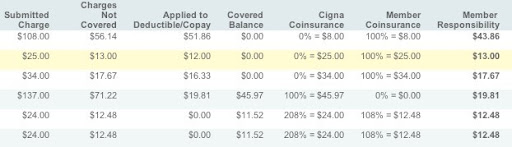
I’m baffled. I know that “Submitted Charge” is the amount the provider submitted. “Charges Not Covered” is the difference between the submitted charge and the negotiated (or contracted) price that Cigna has agreed to pay for the mystery service. We have a $100 copay, so the negotiated price is applied to the deductible until we hit $100, and then it shifts over to “Covered Balance.” So on the first line, 108–56.14=51.86. Fine. But then how is Cigna getting to $8 under “Cigna Coinsurance” and $8 under “Member Coinsurance”? And what are they 0% and 100% of? Well, $8 is 100% of the submitted charge of $108 less the copay of $100, but that makes no sense because the coinsurance is supposed to be calculated based on the negotiated price, not the submitted charge. And $8 isn’t 0% of anything, even with rounding. This utter nonsense continues on the next two lines, where the percentages and the dollar values are completely disconnected.
So how was the final column, “Member Responsibility,” calculated? In the first line, it’s the negotiated price minus either the Cigna coinsurance or the member coinsurance. But on the second and third lines, it’s the charges not covered. On the fourth line, it’s the amount that was applied to our deductible, which is also the negotiated price minus the Cigna coinsurance. So it’s possible that there were only two different calculations used in the first four lines to figure out the Member Responsibility. And one of those calculations might be right.
The fourth line looks like it could be right. We pay $19.81 towards our copay, reaching $100 total, and then the remainder of the negotiated price is paid by Cigna. If the member responsibility is supposed to duplicate the copay amount, then that line is ok.
But then we reach the magical fifth line. Cigna’s coinsurance suddenly jumps to 208%, while the member coinsurance jumps to 108%, for a total coinsurance of 316%. That’s a lot. Strictly as a percentage, 108% is 100 points less than 208%, so it’s the absolute value of X (|X|%) in the formula 208% + X% = 100%, since the two coinsurance percentages should total 100%. And I cannot imagine a reason that a set of calculations like this should ever be using absolute value to convert negative amounts or percentages into positive ones.
Why is Cigna’s coinsurance the exact amount of the submitted charge, and why is the member coinsurance the exact amount of the charges not covered? The total of the two coinsurance payments should be the negotiated price, which is neither of those numbers (and in fact is smaller than either of those numbers).
Perhaps the details are the problem, and I should just look at the totals. The EOB ends up with a total copay of $100 (which is correct), a total member coinsurance of $91.96 (which is not correct), and a total member responsibility of $119.30 (which is neither correct nor connected to the first two numbers). On the summary of claims page, which links to individual EOBs like this one, the total member responsibility is listed as $8.04. That happens to be the difference between the total copay and the total member coinsurance, but there’s no reason why that calculation should ever be done. Nor any reason why the total member responsibility should be different on the summary page and on the EOB.
How an EOB should be calculated
(A) Submitted Charge: A
(B) Negotiated Price (not shown): B
(C) Charges Not Covered: C=A–B
(D) Applied to Deductible/Copay: D=B until deductible/copay is reached, then D=0
(E) Covered Balance: E=B–D
(F) Cigna Coinsurance after out-of-pocket limit is reached: F=100% of E
(G) Member Coinsurance after out-of-pocket limit is reached: G=0% of E
(H) Member Responsibility: H=D+G
How Cigna works
(F) Cigna Coinsurance after out-of-pocket limit is reached: F=A–copay, or F=A, or F=E
(G) Member Coinsurance after out-of-pocket limit is reached: G=F, or G=A, or G=0% of E, or G=C
(H) Member Responsibility: H=D–F, or H=D+G, or H=C
My brain hurts. How’s yours?
Saturday, May 17, 2008
Hello, Adobe?
Hello, Adobe? I have a copy of Creative Suite Premium 1.1 for Mac which I need to reinstall on a laptop, but the second installer disk is unbalanced and won’t read. You have no actual replacement disks? And it takes 48 hours to send out a download link? Ok. A customer only pays about $700 a year for upgrades on this, so it’s probably not worth trying to help. Ok, sure, I’ll wait for 48 hours.
Hello, Adobe? You still haven’t sent the download link. Oh, I see, you transcribed both e-mail addresses incorrectly, and it takes 48 hours to create the link but you still need to remember to send it out? Ok, sure, I’ll keep waiting.
Hello, Adobe? The download link is for Creative Suite 2, which my serial number doesn’t work on. And your ftp server is rather overloaded, so it took close to an hour to get all four disk images downloaded in order to discover this. Oh, you claim the link is definitely for 1.1? And that I must be doing something wrong? Is this like ordering Pepsi, receiving a lobster bisque (which you’re allergic to), and having the waiter insist that it’s Pepsi? No, I can’t turn it into a Pepsi. Yes, I’m quite certain that it’s not a Pepsi. Is there anyone there who knows what they’re doing? Anyone at all? (Three people later.) You’ll send a correct link in an hour? Ok, sure, I’ll wait another hour.
Hello, Adobe? I’ve now spoken to tech support twice, customer support six times, and three days later I am no closer to having CS 1.1 reinstalled on my laptop. I’ve spent about three hours on the phone talking to those 8 people, not a single one of whom has actually taken a useful step toward solving the problem. In fact, not a single one has been able to correctly echo back to me simple statements of the problem on the first try. Is there any other department at Adobe? Perhaps a way to reach a person who knows what they’re doing? Or cares? Or both?
Hello, Quark? Yeah, I know it’s been a really long time, and you’ve probably moved on also (well, actually, you probably haven’t), but do you want to maybe go out for a drink? Just to catch up?
Thursday, April 17, 2008
Data in the neighborhood
I’m trying to read, to see if distractions will help. And up pops yet another story about Comcast disconnecting an Internet customer who is using too much bandwidth. I would be sad if Comcast did that to me, since there is currently no other broadband option to our house. While the AP may lament the Internet being clogged with “bandwidth-sucking data,” I think the Internet would be somewhat less interesting without data.
Some salient features of Comcast’s actions in these sorts of stories as they play out: Comcast’s approach to informing you that you’re using too much bandwidth is to disconnect your Internet and wait for you to call in to complain that it’s not working. Comcast won’t tell you how much bandwidth you’re using, nor what their limits are (and their limits are apparently relative rather than absolute). Most customers have no way to tell how much bandwidth they’re using in absolute or relative terms, and Comcast offers no access to that information. And Comcast offers no options: you cannot pay more for more bandwidth, and you cannot ask for your bandwidth to be capped on an hourly or daily basis. After your first opaque and confusing warning that customer service reps often deny even happened, your next explanation from Comcast is them telling you that they have turned off your account for 12 months, and there is no way to have it turned back on before then.
There are interesting game theory problems embedded here. How do you ensure that you are not one of the highest bandwidth users in your neighborhood without any information about either your usage or your neighbors’ usage? If your Internet connection is slow, is it worth complaining to Comcast when they might then decide that it’s easier to disconnect the highest users (which might include you) rather than add nodes? How does the tension resolve between Comcast wanting to use FUD to convince customers to aggressively limit their own usage and Comcast wanting customers to believe that broadband Internet is worth $54.95 per month? And should you try to convince your neighbors to use more bandwidth, which will slow down your connection, or less bandwidth, which will make it more likely that you are the highest bandwidth user in your neighborhood?
Comcast’s world is more The Prisoner than the prisoner’s dilemma, replete with surveillance, monitoring, and traffic shaping. But really, would it hurt to offer a metered service, or at least a meter and some fixed limits? You and I understand that recursively banning the “worst” 1% of your customers does not have a viable stopping point. But I can just imagine the frustrated Comcast executive looking at the monthly reports, saying “But we banned the worst 1% last month! And now there’s another worst 1%!”
Wednesday, November 28, 2007
Voter pledges
What would you promise to do in order to be allowed to vote? Would you, for example, sign a loyalty oath to a political party? In Virginia, the government will require voters in the upcoming Republican primary to sign a statement saying “I, the undersigned, pledge that I intend to support the nominee of the Republican Party for president.” This is fundamentally wrong.
The pledge can be interpreted in many ways. It could be read as a statement of current intent with no promise of future support. It could also be read as a promise of future support. That future support could be interpreted as donations of time or money to the Republican candidate, or simply a vote in the presidential election for the Republican candidate. How strong does your intent have to be? If you change your mind after the nominees are chosen, or after you learn more about the candidates or the parties or the world, or simply after thinking more, have you broken your signed pledge? If you believe that Romney will be the Republican nominee and you intend to support him, but you would be unwilling to support Giuliani if he is the Republican nominee, can you honestly sign that pledge? Different people will understand the pledge differently, and indeed the linked article offers two different interpretations just a few sentences apart. What is certain is that the pledge will pressure at least some people toward voting for the Republican nominee in the general election, because some people will take what they are signing seriously.
Worse, that pressure will feel like it is coming from the government, rather than from a political party. While a political party is not required to follow anything resembling a democratic process for choosing a nominee, the Republican party in Virginia has chosen to use the state’s electoral process. That electoral process should clearly follow some basic principles in a consistent fashion, so that voters can be assured of the fairness and integrity of the electoral process. Coercion and bias in the state’s electoral process is incompatible with democracy. When the state requires voters in a party’s primary to sign a pledge that they will vote for the party’s nominee in the presidential election, that is coercive. When the state does that only for one party’s primary and not for the other’s, that is both coercive and biased.
The coercion can easily be reinforced after the primary by reminding primary voters of their pledge. Records of who voted in a primary are public. Sample push poll: “Earlier this year, you signed a pledge to support the Republican candidate for president. Do you intend to vote for the Republican candidate tomorrow? [Yes] Thank you for being an honest American. Please remember to encourage your friends to vote tomorrow as well. [No] Are you aware that you signed that pledge? Are you aware that perjury is a crime?” Voter intimidation 101, made even easier by the state having required voters to sign a loyalty pledge in order to vote.
Let’s assume that it’s reasonable for a party to restrict primary voting to members of that political party. (States have different policies on this.) If I am a member of the Republican party, why should I not be able to vote in the primary even if I have no intention of supporting the likeliest Republican nominees for president? Ron Paul supporters, for example, may well realize that their guy has no chance of becoming the nominee and may not want to support anyone else. Why are they not entitled to vote in the primary? Some Republican voters may want to vote in their party’s primary for other local, state, or federal offices, but intend to vote for a non-Republican presidential candidate. Why are they not entitled to vote in the primary?
These objections don’t begin to address the question of what else voters could be required to sign in order to vote. I don’t want to go in that direction, because it might suggest that this loyalty oath is somewhere near the top of a slippery slope. This country has spent many years struggling up a difficult slope towards more free, more fair, and more open access to the right to vote. Loyalty oaths as part of the electoral process are not a small slip down that slope; they are a wholehearted leap downwards.
The two major political parties are very entrenched in our political system, and are very much majority groups. Freedom of association is usually taken to protect our right to join minority groups, but should also protect our right to register as a member of one of those major political parties without agreeing to join in lockstep with every priority of that party. Instead of respecting freedom of association, instead of recognizing the benefits of including different viewpoints, instead of reaching out to independent voters, instead of any pretense of a Big Tent approach, the Republican party is now willing to actively alienate even Republican voters who do not want to subordinate their will to the will of the party. I hope that is not a winning strategy.

